January 9, 2026
As we step into 2026, we are taking a moment to reflect on what 2025 has meant for the Barcelona Declaration on Open Research Information. Spoiler alert: it has been a very significant year.
Advancing step by step
Throughout 2025, the Barcelona Declaration continued to grow as a community-driven initiative, advancing step by step. Some of this work has already resulted in concrete outcomes; other efforts are still unfolding and will take shape in 2026.
What ties it all together is a shared commitment to improving the openness, transparency, and community governance of research information. Below, we highlight some of the key moments and developments from the past year.
Key moments and developments
We signed a Memorandum of Understanding (MOU) securing three years of funding for the Barcelona Declaration from CWTS, SIRIS and Crossref.
We established the Barcelona Declaration Coordination team, with Bianca Kramer as Executive Director and Bárbara Rivera López as Community Manager.
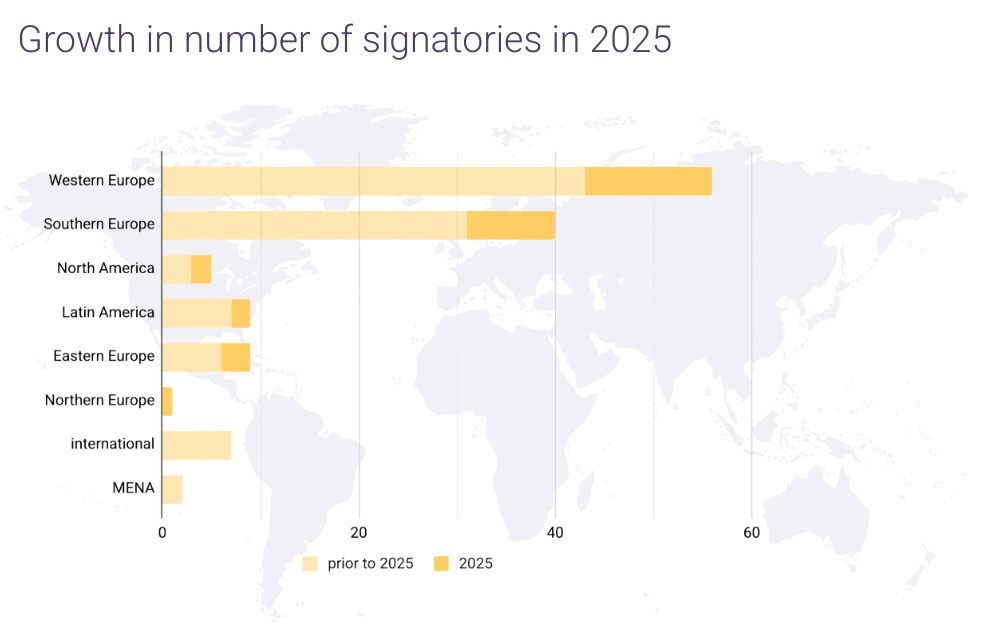
Our community grew in 2025, with 30 new signatories and 7 new supporters from 17 countries worldwide, across universities and research-performing organizations, funders and governments, and other organizations. Among new signatories are Wellcome Trust, California Digital Library, and Fundación “la Caixa”.
In May, we gathered in person in Italy for the Bologna Meeting on Open Research Information, with the meeting’s Report published on Zenodo and the morning session recording available on our YouTube channel.
Community-led National Networks emerged in 2025 as spaces for shared learning and local implementation of the Barcelona Declaration commitments, with networks established in the Netherlands, the German-speaking countries, and Italy, and France exploring next steps.
During 2025, the seven Barcelona Declaration Working Groups advanced their work through community-guided processes. Several Working Groups also established task forces to focus on specific challenges. Some concrete outcomes are listed in the box below.
Working group outcomes
- Working Group 1 (Journal article metadata and book metadata) established a joint task force with OA2020 to negotiate openness of publication metadata.
- Working Group 3 (Funding metadata) convened a
- Working Group 5 (Sustaining infrastructures) organized two online mutual-learning sessions focused on the sustainability of open infrastructures. The recording of the session with OpenAlex, OpenAIRE, and OpenCitations is available here; the session with related initiatives (IOI, SCOSS, and TSOSI) can be found here.
- We co-hosted, through Working Group 4 (Replacing closed systems), a webinar with the Helmholtz Open Science Office on institutional journeys toward open, non-proprietary systems, featuring practical experiences shared by signatories from Italy, Germany, Colombia, and the Netherlands. The recording will be available soon.
- We established two task forces within Working Groups 1 and 3, each with a shared focus on regional outreach and support for smaller, under-resourced organizations.
Throughout 2025, the Barcelona Declaration engaged with diverse stakeholder communities interested in open research information through participation in key meetings and events across different regions. Highlights are outlines in the boc below:
Conference highlights
- STI-ENID Conference, organizing a discussion session on open research information for the bibliometrics community.
- LIBER and DCMI Annual Conferences and the DCMI Metadata Clinic, engaging with the library community around open research information, including on the opportunities and challenges of generative AI.
- Munin Conference, focusing on strategies for publishers to make publication metadata openly available.
- Latmetricas, contributing to discussions on territorial and responsible metrics in Latin America.
- 2nd Ibero-American Congress on Open Science, engaging with the Latin American open science community.
In 2025, we also explored closer coordination with related initiatives. The Barcelona Declaration joined the National and International Initiatives Discussion Group led by DORA. We were also happy to see the relation between publishing reform and research assessment reform discussed at a workshop in Pisa organized by ASAPbio, CWTS, DORA and the International Science Council, given the connection of both agenda’s with open research information. We are also looking forward to furthering our connections with CoARA and OSMI in 2026.
Continuing this work together
Thank you to everyone who actively contributed to the Barcelona Declaration in 2025. We are grateful to share this work with a community for whom open research information matters as much as it does to us.
As we begin 2026, we look forward to continuing this work together. If you are interested in signing the Barcelona Declaration, you can reach us at contact@barcelona-declaration.org. You can also stay in touch by following us on social media (LinkedIn, Mastodon & Bluesky), and exploring recordings on our YouTube channel.