November 10, 2026
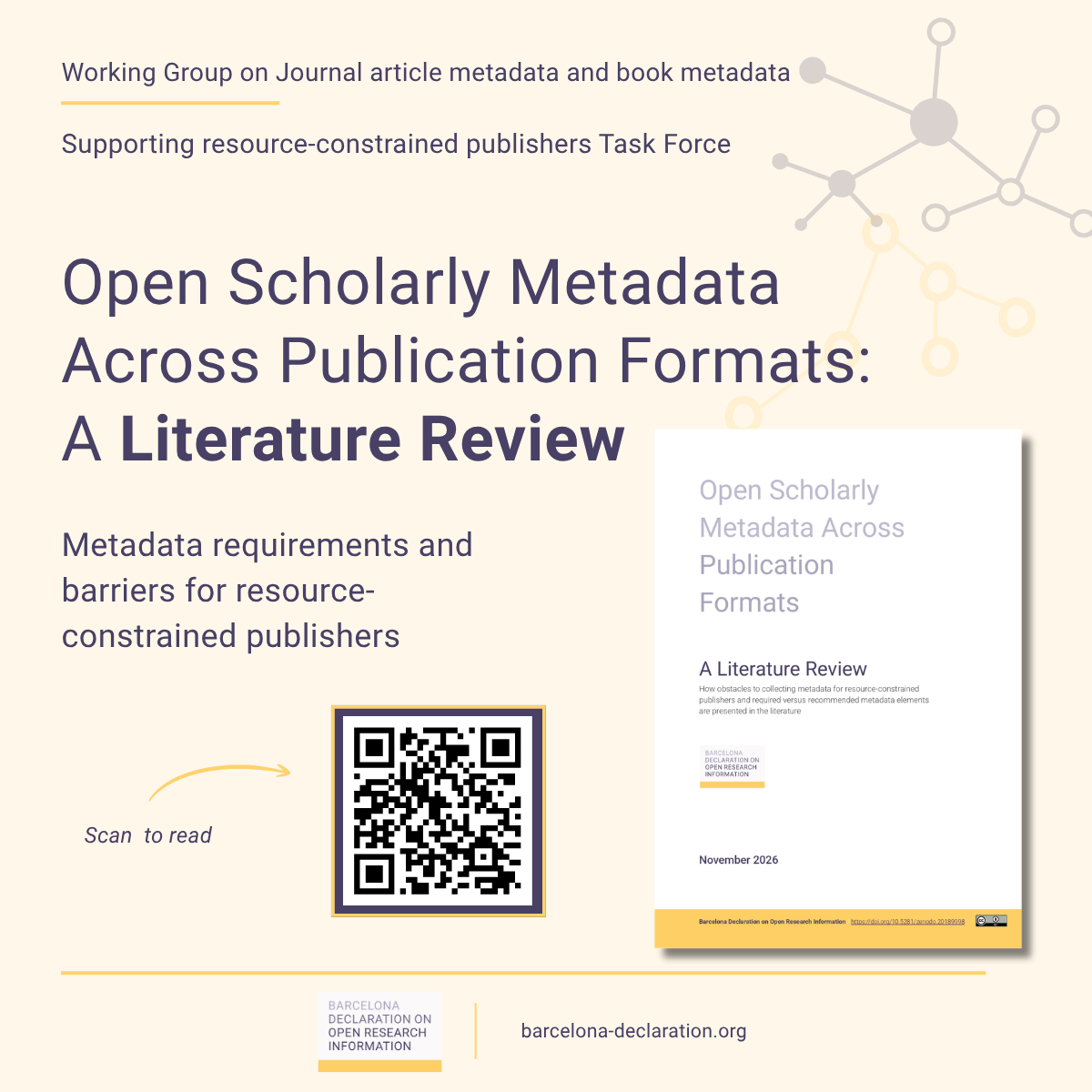
A new report, Open Scholarly Metadata Across Publication Formats: A Literature Review, examines the barriers that can make it harder for publishers with limited resources to collect and share metadata. It was produced by the Barcelona Declaration’s Working Group on Journal and Book Metadata, through its Task Force on Supporting Resource-Constrained Publishers, led by Dominic Mitchell (DOAJ).
 |
The review brings together literature in English, Spanish, Portuguese and German, considering metadata across journals, books, book chapters, conference proceedings, datasets, software, preprints and repository records. It identifies barriers across four areas of the metadata lifecycle: creation, curation, processing, and interoperability.
Its focus on resource-constrained publishers also has a wider relevance: publishers with limited capacity work in many parts of the world, and their outputs are part of the scholarly record. When those outputs are harder to represent in open metadata, the picture available to researchers and the wider community can be incomplete.
By bringing evidence together across formats and perspectives, the review offers a starting point for recognizing recurring barriers and discussing what could help make open research information more inclusive.
Read the full review to explore the findings and the questions they raise for making open research information more inclusive: https://doi.org/10.5281/zenodo.24084581